Shop · Pastry
Volume XXI
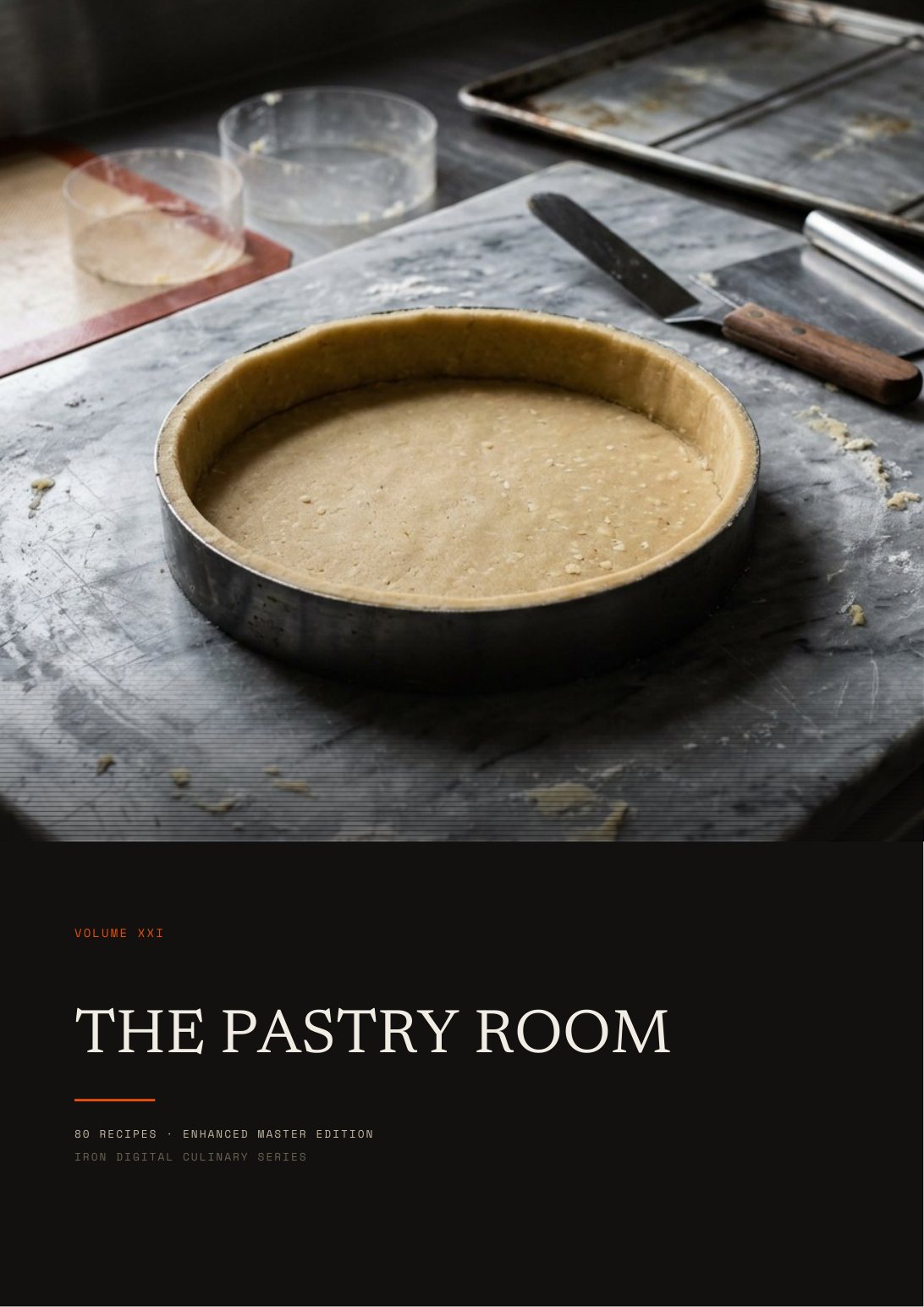
The Pastry Room
Eighty recipes for pâtisserie built the way a pastry section builds it: the components first — creams, meringues, choux, doughs, mousses, glazes — and then the assemblies that stand on them. An entremet names its mousse, its insert, its crunch layer and its sponge by number instead of restating fifty ingredients, so when one goes wrong you know which one.
Try 48 recipes free — two from every book, including this one.
What's inside
The parent cream, and everything folded into it.
Which of the three meringues each job wants.
Closing on six ways it goes wrong.
Judged on the shell before anything goes into it.
How much gelatine each one actually needs.
These are the last two hours, where it is won or lost.
Built upside down, and frozen.
Plus what gets made at six in the morning.
Sample recipe · page 10
Éclairs, Piped and Glazed
- 600 g pate a choux, from recipe 21
- 700 g creme patissiere, from recipe 1
- 200 g fondant icing
- 2 tbsp glucose syrup
- 100 g dark couverture, 64%
- 1 tbsp cocoa
- Pipe 12 cm lengths with a star nozzle held at 45 degrees, pulling evenly. The ridges from the star stop the top splitting.
- Bake at 190°C for 20 minutes, then drop to 160°C for 15 more without opening the door.
- Pierce each one underneath as it comes out. Trapped steam softens the shell from the inside within minutes.
- Cool completely, then fill through three holes in the base until the eclair feels heavy and even in the hand.
- Warm the fondant to 35°C with the glucose and a little water until it flows. Hotter than 37°C and it dries dull instead of glossy.
- Dip the top, draw it across the rim of the bowl, and set it down. Fill and glaze on the day they are eaten.
The rest of the shelf
All 24 in the shop — 1758 recipes across the shelf.